
Green Winged Teal: Fun Facts
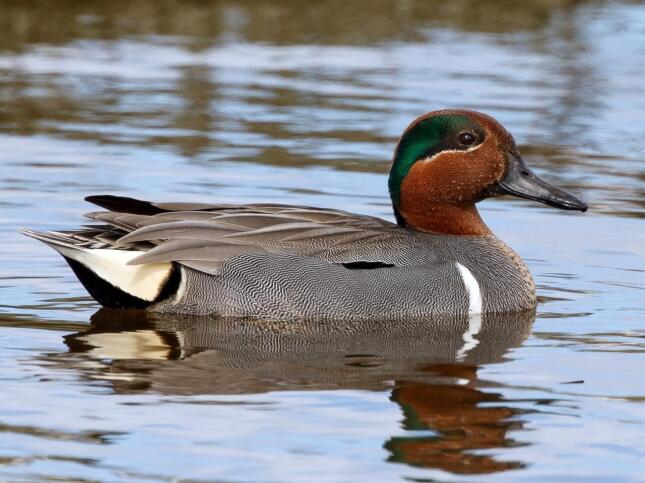
•The little Green-winged Teal is the smallest dabbling duck in North America. The natty male has a cinnamon-colored head with a gleaming green crescent that extends from the eye to the back of the head. In flight, both sexes flash deep-green wing patches (specula). Look for them on shallow ponds and in flooded fields, and listen for the male’s decidedly non-ducklike whistle. These common ducks breed along northern rivers; wintering flocks can number as many as 50,000
• Green-winged Teal breed mostly in isolated river deltas, forest wetlands, and mixed prairie regions across northern North America—they occur in the prairie pothole region, but they are not as restricted to it as many other dabbling ducks. Nesting sites include grasslands or sedge meadows that provide brush thickets of sedge or cattail for cover, and weedy or burned areas. They also favor beaver ponds in wooded areas, and nest along streams, potholes, lakes, and human made wetlands.
• Green-winged Teal eat mainly aquatic invertebrates and seeds. They feed in shallow water, near shorelines, on mudflats, and in agricultural fields, taking advantage of whatever foods are most abundant.
• With the male following behind, the female chooses a well-concealed site on the ground, usually within about 200 yards of water. Nests are typically built in sedge meadows, grasslands, brush thickets, or in woods near a pond. The female chooses a spot that offers dense cover that may form a complete canopy over the nest. The female uses her feet to scrape a nest bowl where she lays the first egg, then adds plant material such as grasses, sedges, and leaves from around the nest site, using a sideways motion of her bill to build up a nest measuring 6–7 inches across and 2–6 inches deep. After laying her last egg, the female adds her down feathers to the nest bowl before beginning to incubate.
• The oldest known Green-winged Teal was at least 20 years, and 3 months. It was a female banded in Oklahoma in 1941 and recovered by a hunter in Missouri in 1960.