
Mallard Ducks: Fun Facts
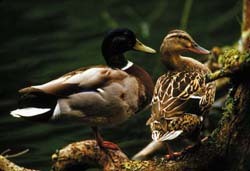
• The Mallard is the ancestor of nearly all domestic duck breeds (everything except the Muscovy Duck). Domestic ducks can be common in city ponds and can be confusing to identify—they may lack the white neck ring, show white on the chest, be all dark, or show oddly shaped crests on the head.
• The widespread Mallard has given rise to a number of populations around the world that have changed enough that they could be considered separate species. The "Mexican Duck" of central Mexico and the extreme southwestern United States and the Hawaiian Duck both are closely related to the Mallard, and in both forms the male is dull like the female. The Mexican Duck currently is considered a subspecies of the Mallard, while the Hawaiian Duck is still given full species status.
• Mallard pairs are generally monogamous, but paired males pursue females other than their mates. So-called “extra-pair copulations” are common among birds and in many species are consensual, but male Mallards often force these copulations, with several males chasing a single female and then mating with her.
• Mallard pairs form long before the spring breeding season. Pairing takes place in the fall, but courtship can be seen all winter. Only the female incubates the eggs and takes care of the ducklings.
• Ducks are strong fliers; migrating flocks of Mallards have been estimated traveling at 55 miles per hour.
• The standard duck’s quack is the sound of a female Mallard. Males don’t quack; they make a quieter, rasping sound.
• Mallards, like other ducks, shed all their flight feathers at the end of the breeding season and are flightless for 3–4 weeks. They are secretive during this vulnerable time, and their body feathers molt into a concealing “eclipse” plumage that can make them hard to identify.
• Many species of waterfowl form hybrids, and Mallards are particularly known for this, hybridizing with American Black Duck, Mottled Duck, Gadwall, Northern Pintail, Cinnamon Teal, Green-winged Teal, and Canvasback, as well as Hawaiian Ducks, the Grey Duck of New Zealand, and the Pacific Black Duck of Australia.
• The oldest known Mallard was a male, and at least 27 years, 7 months old when he was shot in Arkansas in 2008. He had been banded in Louisiana in 1981.