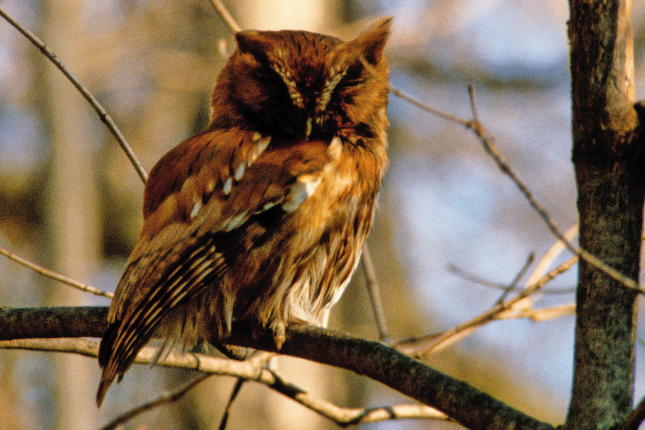
Common east of the Rockies in woods, suburbs, and parks, the Eastern Screech-Owl is found wherever trees are, and they’re even willing to nest in backyard nest boxes. These supremely camouflaged birds hide out in nooks and tree crannies through the day, so train your ears and listen for them at night.
Like most raptors, male Eastern Screech-Owls are smaller than females, and are more agile fliers and hunters. The female doesn’t hunt while on the nest; she and the chicks depend on food brought them by the male. Though the male is smaller, his voice is deeper than the female’s.
Smaller birds can help you find screech-owls during the day. Listen for a commotion of Blue Jays, chickadees, and titmice—they may be mobbing a screech-owl (or other raptor), swooping around it with noisy calls.
Screech-owls regurgitate the bones, fur, and feathers of their prey in an oval pellet, usually once or twice a day. The ground beneath habitual owl roosts can be littered with pellets, and you can learn a lot from them about the owl’s diet. However, data from pellets may underestimate the number of soft-bodied animals, like worms and insects, the owl has eaten.
Eastern Screech-Owl pairs usually are monogamous and remain together for life. Some males, however, will mate with two different females. The second female may evict the first female, lay her own eggs in the nest, and incubate both clutches.
The Eastern Screech-Owl is known to eat a variety of songbirds, including the European Starling. Despite this fact, the starling regularly displaces the owl from nesting sites and takes over the hole to raise its own brood.
Nestling screech-owls fight fiercely among themselves for food, and sometimes even kill their smallest sibling. This behavior, known as siblicide, is not uncommon among birds such as hawks, owls, and herons, and is often a result of poor breeding conditions in a given year.
The oldest recorded Eastern Screech-Owl in the wild was at least 14 years, 6 months old when it was found in Ontario in 1968, the same province where it had been banded in 1955.